
Surviving Turnpike Tollhouses
·
A list
of tollhouse sites in specific counties can
be found by clicking on these links; Berkshire,
Buckinghamshire, Cornwall, Dorset, Devon, Gloucestershire, Oxfordshire, Somerset.
|
|
|
|
|
|
Monksbridge Tollhouse, Brixham, |
Tidmarsh Tollhouse, |
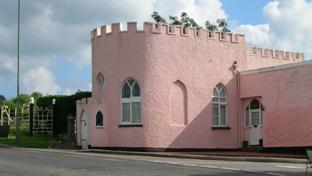
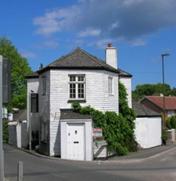
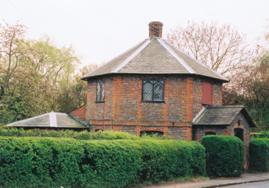
There are many more surviving examples of tollhouses in the
Southwest of England, particularly
Surviving tollhouses are grouped under a
number of generic categories on the tollhouse
design page.
A few tollhouses were built to collect tolls at bridges over which roads pass and these are included in our survey. Many toll bridges were bought out by County Councils in the mid-20th century but these are a small number of private toll bridges with associated tollhouses that remain in regular use. (see http://www.flickr.com/photos/tollhouses/sets/72157603743779199/ ) Tolls were also collected on canal traffic but these are not part of the study.
Building Turnpike Tollhouses
The turnpike trusts erected gates across the road at strategic points to collect tolls from travellers from outside the Parish. Small lodges or cottages were built to house the toll collectors and these tollhouses were significant investments for the trust. The tollgates were often built at points were it was least likely that vehicle or horse users could evade payment; e.g. at bridges, crossroads or where the adjoining ground constricted the road. Early tollhouses were normally in the vernacular style of the local cottage but by the 19th century a particular style was evolving. Although this derived some features from the lodges built at the entrance to grand estates, there was considerable local distinctiveness in the design of the tollhouses built by the individual trusts. The classic design of a single story cottage with a polygonal (canted) bay front dates from the 1820s when turnpike roads and the coach traffic they carried were at their peak. However, many simple buildings were also built to house the pikemen who manned the gates on lesser highways. On the major roads grand castellated houses were constructed at considerable expense to impress the wealthy travellers and influence their selection of one route over another. Unlike the present attitude to road development, turnpikes were welcomed by market towns since they improved trade and brought more travellers past their businesses. The tollhouses were generally placed outside the urban area. This avoided tolls on local business and maximise the collection of charges on those long distance travellers from outside the parish, who were benefiting from using the improved turnpike road. However, these isolated sites were vulnerable to thieves and highwaymen and so the windows of the tollhouse would routinely be fitted with stout bars, behind the grand facade and have built-in safes to safeguard the cash kept in the office.
Although the tollhouse was often the most prominent feature of the turnpike gate, as important to the toll collector was the gate. These were built to bar free-passage along the road and were generally stout and substantial. During the day they may have been left open, or at least ajar, on a busy road but at night were closed and the pikeman would need rousing to take the toll (or, heralded by a coach horn, let the mail coach through free of toll). Although contemporary illustrations suggest that large wooden gates were common, in the 19th century wrought iron gates were fitted; it is these metal gates that have survived best.
The end of the road for Turnpike Tollhouses
When the turnpike trusts were closed and the gates removed in the 1870s the tollhouses were sold along with all other assets in order to pay off remaining loans or contribute to the parishes and Highway Boards that took over responsibility for the road. Highway Boards often required the tollhouses to be “caste into the road” since they restricted the flow of traffic. However, a considerable number were sold to adjoining land owners or were auctioned and have remained in private hands ever since. Wayside businesses such as inns, post-offices, blacksmiths and later petrol stations found these sites convenient but the majority have become domestic dwellings. There has been steady erosion in the number of surviving tollhouses, and those that have remained have often been altered out of all recognition by extensions and modernisation. Listing by English Heritage has ensured that the external features such as bay fronts and toll boards recesses have been preserved during any restoration or extension needed to provide modern accommodation. Nevertheless the few very good examples of tollhouses, restored to near original condition can only be found in open air museums, notably Ironbridge Gorge Museum, Chiltern Open Air Museum, Weald & Downland Open Air Museum, Welsh National History Museum at St Fagans near Cardiff and Avoncroft Museum in Bromsgrove. The turnpike gates and fencing were also sold off and some distinctive metal gates and posts, for instance the radial sunburst design, can be found on private property close to an old turnpike.
There are several working tollgates in
More Information
You may find some information on tollhouses hosted on the site set up by John Nicholls for Roadside features at http://www.milestonesonline.co.uk/tollhouses.htm
If you have questions or information relating to tollhouses you may contact me at rosevear1@aol.com.
TOLLHOUSE BIBLIOGRAPHY
Anon (1998) Turnpikes & Tollhouses,
Avery- Fowler, J.A. (1936) Road
Trusts in East Sussex,
Bentley, J.B. & Murless, B.J. (1985-7) Somerset Roads; The Legacy of Turnpike roads Phases 1 & 2, publ. Somerset Archaeology Society.
Cox, B.G. (1980) The Vale of Evesham Turnpikes, Tollgates and Milestones , publ by Vale of Evesham Historical Society.
Emmison, F.G. (1936), Turnpike Roads & Toll Gates of Bedfordshire in "Survey of ancient buildings" Vol III, publ. The Bedfordshire Historical Record Society.
Freethy, R. (1987) Turnpikes and Tollhouses of
Harris, R. ed. ( )
Haynes, R. & Slocombe, I. (2004) Wiltshire Toll Houses, publ.
Hobnob Press,
Jenkinson, T. (2007) Old Toll-houses of
Jenkinson, T. (2007) Old toll-houses of Dartmoor towns and villages
Part 2: South and
Jenkinson T. & Taylor, P. (2009) The Toll-houses of South Devon, publ. by the authors and Polystar Press. (ISBN 978 1 907154 01 0)
Jenkinson T. & Taylor, P. (2010) The Toll-houses of North Devon, publ. by the authors and Polystar Press. (ISBN 978 1 907154 03 4)
Kanefsky, J. (1976) Devon Tollhouses, Exeter Ind Arch. Group,
Raikes, C. (1978), Portraits of Devon Tollhouses, Exeter Ind Arch Group. (ISBN 0 90623-01-9)
Rosevear, A. (2004) RUTV10; Milestones and Tollhouses on old turnpike Roads (privately published)
Searle, M. (1930), Turnpikes and Toll-bars, publ.
Serjeant, W.R. & Penrose, D.G.
(eds) (1973) Suffolk Turnpikes, E Suffolk RO
Sheldon, L. (1933)
Taylor, P. (2001) The Toll-houses of
Taylor, P. (2009) The Toll-houses of Norfolk, publ. by the author and Polystar Press. (ISBN 978 1 907154 02 7)
Taylor, P. (2009) The Toll-houses of Suffolk, publ. by the author and Polystar Press. (ISBN 978 1 907154 00 3)
Tonkin, M. (1996) Herefordshire Toll
Houses – then & Now, Trans. Woolhope Soc, Vol. 48.
Viner, D. (1969) The Industrial Archaeology of Hampshire Roads : a survey" in Procs. Hampshire Field Club & Arch. Soc . vol. 26 for 1969, pp. 155-72.
Viner, D. (1970) "The toll-house at Charminster, Dorset"
in Procs.
Viner, D. (1975) "Roads and toll-houses" in Hampshire
Industrial Archaeology: a guide,
Viner, D. (1981) "Turnpikes and toll-houses" in Popular Archaeology, vol. 2. no. 7, January 1981, pp. 21-3.
Viner, D. (1982) "The turnpike toll-house" in Period Home, vol. 3 no. 2, Aug-Sept. 1982, pp. 5-12.
Viner, D. (1982) "The Wimborne & Puddletown Turnpike Trust (1864-/8) and the toll-house at Athelhampton" in Procs. Dorset Nat. Hist. & Arch. Soc., vol. 104 for 1982, pp. 25-32.
Viner, D. (1987) "The Kington Turnpike Trust (1756-1877) and
the
Viner, D. (2007 ) Roads Tracks and Turnpikes in the Discover Dorset series. Dovecote Press, Wimborne

This page created by Alan Rosevear 11th Jan 2008.
Edited 26th July 2010.