
Milestones
in the Thames Valley
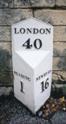 (A cast iron milepost on the
 Bath Road Reading
Alan Rosevear is the Database Manager for
the Milestone Society; the
Society has a comprehensive database of surviving and restored milestones
throughout the
Milestones
in the West Country  (Milestone near
 Dorchester )
Pictures of some milestones in

--------------------------------------------------------------------------------------------------------------
Milestones
Conservation 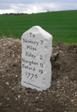 (Restored Milestone at Beedon Hill,
West Berks)
(Restored Milestone at Beedon Hill,
West Berks)
During the later part of the 20th century milestones were no longer important for providing information to road users. Highway Authorities dropped them from routine maintenance programmes and a period of neglect followed in many counties. Vegetation grew up around the milestones, the paint fell away and the exposed stone began to erode. Now lost in the hedge or verge, milestones were not visible to road maintenance gangs and many milestones were seriously damaged by impacts from hedge cutters, flails or power mowers. Milestones and mileposts that were clearly uncared for attracted souvenir hunter, thieves and misguided collectors. Metal plates in particular, have been removed at an alarming rate, often leaving damaged or defaced stones. Despite many milestones and mileposts being given protected status as Grade II Listed monuments, authorities were often unaware of the decay, damage and theft that was occurring unnoticed on remote roadside verges.
Since its formation in 2000, The Milestone Society has striven to reverse this steady erosion of our heritage. Where possible it has encouraged local authorities and local communities to resume maintenance and protection programmes. Recognition of milestones as part of an area’s local character and the greater use of old lanes for leisure activities has made it easier to obtain grants for restoration of unbroken series of stones along particular routes. The Milestone Society has published Guidance on the conservation of stone and metal waymarkers (see the Milestone Society web site). In many instances Milestone Society members have themselves undertaken the conservation work and finance the replacement of lost mileplates. Examples of conservation work undertaken by this author can be seen on Flickr by clicking on;
; http://www.flickr.com/photos/tollhouses/sets/72157607756645268/
--------------------------------------------------------------------------
Non-Turnpike
Waymarkers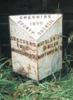
Not all milestones date from the turnpike era. For instance, Roadside Crosses survive from before the turnpike era when any guidance across the open moors and heaths was welcome and additional divine assistance was often needed.
To see information on wayside markers erected before the turnpike era click on Wayside Crosses and Guide stones.
Click on Non-turnpike milestones, to see information on waymarkers erected by County Councils and other bodies after the turnpike era.
-------------------------------------------------------------------
Sign
Posts etc.
Most of the surviving fingerposts beside our roads
were erected by (and in general continue to be maintained by) County Highways
Departments. Examples of fingerposts in the West Country are pictures in a set
on my Flickr page; http://www.flickr.com/photos/tollhouses/sets/72157604651791928/

------------------------------------------------------------
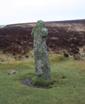
Some other roadside features are pictured in the set;

http://www.flickr.com/photos/tollhouses/sets/72157603888550104/
------------------------------------------------
Milestones
and Waymarkers in England
Look at http://www.milestonesonline.co.uk/ for a comprehensive view of current issues on waymarkers and http://uk.groups.yahoo.com/group/milestones-waymarkers/ for recent information on all waymarkers.
More local information on milestones in
for Greater Yorkshire milestones there is the excellent site at http://www.yorkshire-milestones.co.uk/; and
for maps of milestone distribution http://pnelson.orpheusweb.co.uk/.
A comprehensive survey of boundary markers
in
This page created by Alan Rosevear 11th Jan 2008.
Last Edited 26th July 2010.